
There are warnings we can’t afford to ignore anymore if we truly want to be healthy. I’ve been talking about eating well for years, but we’ve reached a point where the choices we make about our food—and where it comes from—matter more than ever. If we ignore that, we shouldn’t be surprised when unexplained health issues begin to show up.
I’m not speaking from a place of fear, and I’m not claiming to be immune. None of us are. Every good thing we have is given from above, and this message isn’t meant to alarm you, but to affirm what many are already sensing or becoming aware of.
I’m also not here to promote any one farm or solution. What I have access to right now is a blessing for this season, but my trust isn’t in any one source—it’s in God, who provides all good things. This is simply a reminder for those who may not yet realize how much our food system has changed over the past 20 years, and how quickly those changes are accelerating.
You might wonder how we got here. The truth is, it’s been shaped by many small choices—both individually and collectively—along with leadership that hasn’t always acted in the best interest of people. Scripture reminds us that the enemy comes to steal, kill, and destroy, but we are also given wisdom so we can live with discernment and thrive. We are called to be “wise as serpents and innocent as doves” (Matthew 10:16).
Hold onto that as you make daily decisions.
This isn’t about fear—it’s about awareness and wisdom. Pray over your choices. Ask for guidance. Whenever possible, seek out local sources for your food. Not everything in the grocery store is harmful, but the quality of what’s available is shifting, and not always for the better. It’s no longer just about obvious processed foods—changes are happening across the board, even in produce and meat.
Again, don’t be afraid—but don’t stay unaware.
At the end of the day, none of us are getting out of this life unchanged. But if we have the opportunity to make better, wiser choices—why wouldn’t we?
It can be simpler than it seems. Start by asking:
Who is producing my food?
Where is my money going?
Does this support something good for my body and my community?
Do these producers have integrity?
These questions may feel like a lot, but the details do matter—especially when it comes to what we put into our bodies. If you’ve ever dealt with a food sensitivity or allergy, you already understand how important this is.
Be mindful. Seek wisdom. Pray for direction. Ask God to lead you to the right sources in your area. Pay attention to what you find—it may matter more than you realize right now.
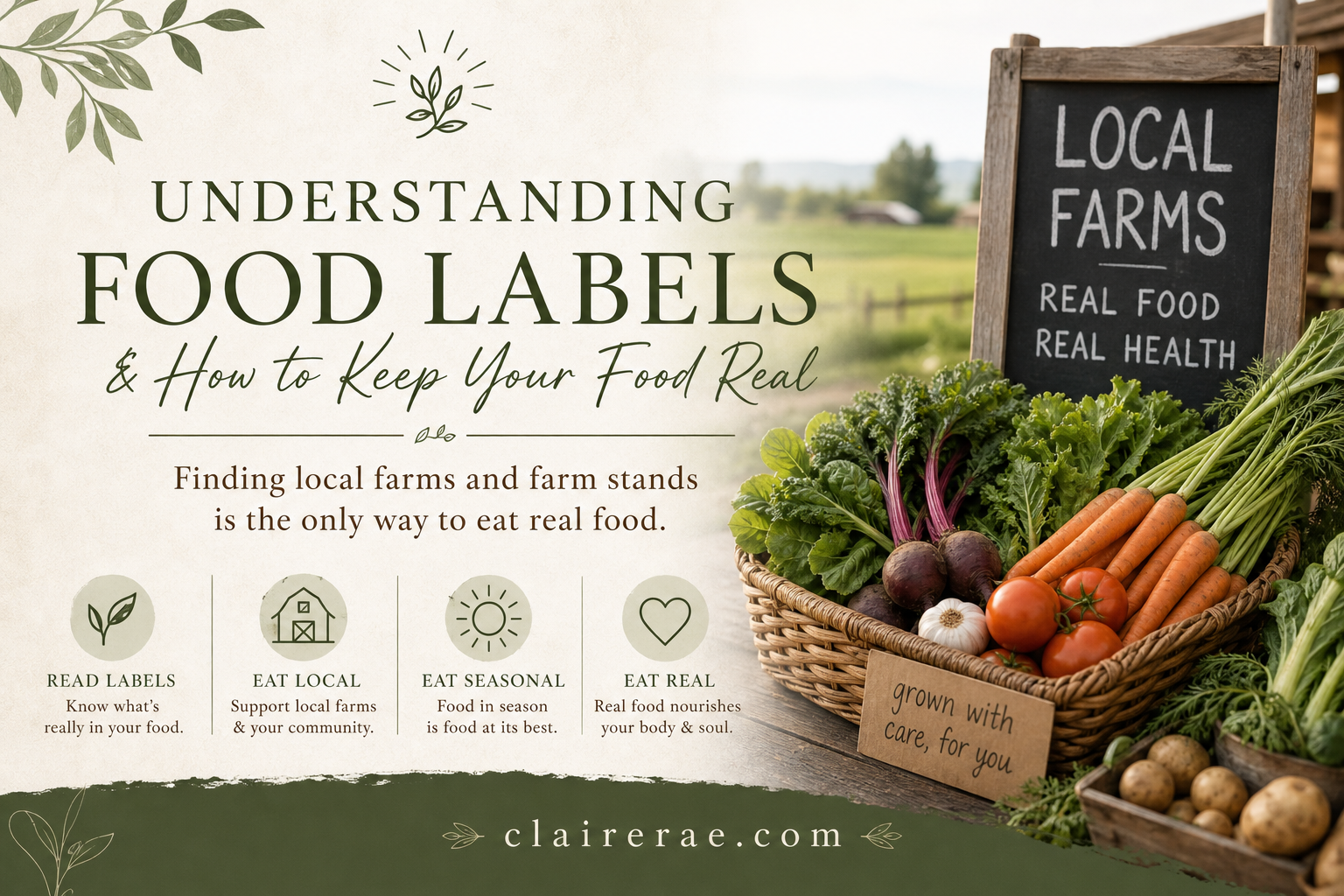
Understanding Food Labels & Keeping Your Food Real
Why going local might be the most honest way to eat
Walk into any grocery store and you’re met with a wall of promises—natural, organic, whole grain, plant-based, no added sugar. It looks like health. It sounds like health. But if you flip the package over, the truth is usually far more complicated.
If you want to eat real food—food that actually nourishes your body—you have to learn how to read between the lines. And more often than not, that journey leads you out of the grocery aisle and straight to local farms and roadside stands.
The Illusion of Food Labels
Food labels are designed to sell, not to inform.
Terms like “natural” and “made with real ingredients” have no strict, meaningful definition in many cases. Even “organic,” while regulated, doesn’t necessarily mean fresh, local, or nutrient-dense—it can still be processed, packaged, and shipped thousands of miles before reaching your plate.
Here’s what to watch for:
- Long ingredient lists – Real food doesn’t need a paragraph to explain itself.
- Unfamiliar names – If you can’t pronounce it, your body may not recognize it either.
- Hidden sugars – Words like maltodextrin, dextrose, and cane juice all point back to sugar.
- Seed oils and additives – Common in processed foods, often inflammatory and heavily refined.
A simple rule: the more packaging and marketing involved, the further you are from real food.
What “Real Food” Actually Means
Real food isn’t complicated—it’s just been buried under layers of convenience culture.
Real food looks like:
- Vegetables grown in soil, not factories
- Meat raised on pasture, not in confinement
- Eggs from chickens that see sunlight
- Milk that hasn’t been stripped, altered, and rebuilt
- Bread made from simple ingredients, not preservatives
It’s food that your great-grandparents would recognize instantly.
Why Local Farms Are the Answer
If grocery store labels are confusing, local farms are refreshingly simple.
There’s no marketing team, no deceptive packaging—just people growing food.
When you buy from a farm stand, you’re not decoding a label. You’re having a conversation.
You can ask:
- How was this grown?
- What was used on it?
- When was it harvested?
- How were the animals raised?
And you’ll get a real answer.
That level of transparency doesn’t exist in large-scale food systems.
The Nutrient Difference
Food from local farms is often:
- Fresher – picked at peak ripeness, not early for shipping
- More nutrient-dense – less time between harvest and consumption
- Free from unnecessary additives – no need for preservatives when food is fresh
A tomato from a grocery store might look perfect, but a tomato from a local farm will taste alive. That difference isn’t just flavor—it’s nutrition.
The Hidden Cost of Convenience
Processed food is built for shelf life, not human life.
It’s engineered to:
- Be addictive
- Be cheap to produce
- Last as long as possible
But the cost shows up later—in gut health issues, inflammation, fatigue, and chronic disease.
When you rely on packaged foods, you’re often trading short-term convenience for long-term health.
Finding Real Food Near You
If you’re ready to step out of the system, here’s where to start:
- Farm stands – Often right on the roadside, especially in rural areas
- Farmers markets – A hub of local growers and seasonal food
- Community-supported agriculture (CSA) – Weekly boxes directly from farms
- Local directories & word of mouth – Ask around—people who eat real food usually know where to find it
Living in or near a place like Vancouver gives you access to an incredible range of farms, especially in nearby regions like the Fraser Valley but don’t limit yourself wherever you live, there are farmers markets in each city so don’t make excuses, just rearrange your schedule and make it work. What you avoid now, will show up later with regret if you don’t.
Eating With the Seasons
One of the biggest mindset shifts is learning to eat what’s in season.
Real food isn’t available year-round in the same way—and that’s a good thing.
Seasonal eating:
- Aligns your body with natural rhythms
- Supports local farmers
- Ensures you’re getting food at its nutritional peak
It also reconnects you to the land in a way grocery stores never will.
The Truth: Real Food Requires Intention
There’s no shortcut to eating real food.
It takes:
- Planning
- Effort
- Awareness
But what you gain is far greater:
- Better health
- Stronger connection to your food
- Support for local communities
- A deeper sense of trust in what you’re eating
Final Thoughts
Understanding food labels is a good first step—but it’s not the final answer.
Because the truth is, the healthiest food often doesn’t need a label at all.
It’s grown by someone you can meet.
Picked not long before you eat it.
And sold without a list of ingredients—because it is the ingredient.
If you want to keep your food real, step away from the packaging and step toward the source.
That’s where real nourishment begins.
